About the Journal
Aims and Scope
Founded in 1987 as a multidisciplinary journal focused on spatial development, Tér és Társadalom (“Space and Society”) has established itself as Hungary’s leading theoretical journal for social sciences concerned with spatial issues. Owing to the complexity of spatial problems, and the intricate interactions between “space and society”, the journal aims at theoretical and methodological plurality in spatial research, taking a multidisciplinary approach. It welcomes papers on economic, social, political-administrative, cultural and environmental issues and engages with spatial problems at the subnational, national, and supranational spatial scales. It specifically prefers theoretically well-grounded, empirically sound, and policy-relevant papers offering deeper insight and robust conclusions on regional problems.
The journal has a particular interest in embedding Central and Eastern European spatial development experience within global conceptual and theoretical advances, and generalising CEE research achievements to formulate sound academic and policy contributions. It thus promotes knowledge exchange among researchers involved in CEE-relevant spatial problems, with an openness towards the broader European and global perspective. Through understanding CEE in the global context, it supports national- and EU-level sectoral and regional policies, and offers relevant insights for an international readership within and beyond the focus region..
Tér és Társadalom (“Space and Society”) publishes original research papers (including theoretical, empirical, comparative, and policy-oriented studies), review articles, and special issues devoted to current problems. It accepts high-quality contributions ensured by a double-blind peer review process. The journal currently accepts papers in the Hungarian according to its mission as the main forum of Hungarian-language multidisciplinary regional research; and English, in light of its openness toward the international scientific community.
History
Tér és Társadalom (“Space and Society”) was founded in 1987 as a multidisciplinary journal of the Centre for Regional Studies of the Hungarian Academy of Sciences, focused on spatial development. As György Enyedi, the first head of the editorial board formulated, Tér és Társadalom “does not publish achievements of one single discipline, but scrutinizes the relationship between space and society from various perspectives of different disciplines in a specific way”. As the publisher and its successor organisations have operated as a networked institute with locations in multiple cities across Hungary, the work of the editors has always featured a high degree of decentralisation and spatial cooperation.
The journal was edited by József Tóth in Pécs between 1987 and 1988, then by Pál Beluszky in Budapest between 1989 and 1993. These years saw the publication of papers often dealing with the foundational and conceptual issues of spatial development, as well as the implications of systematic change in Central and Eastern Europe. In this period, Tér és Társadalom published noteworthy international papers in Hungarian translation as part of its mission to disseminate state-of-the-art theories and concepts in the domestic research community. Another dimension of internationalization since the start of the journal can be grasped in the inclusion of Hungarian researchers living in the neighbouring countries. The journal started publishing thematically focused special issues alongside general papers from 1989.
From 1994 until 2010, Tér és Társadalom was published by an editorial team in Győr led by János Rechnitzer. While retaining its embeddedness in theoretical and conceptual matters, this period also saw a heavy focus on the emerging new paradigms of regional development and regional policy in Central and Eastern Europe. The journal’s debates have thus contributed to public policy and the institutional framework of regional development which took place in the years of EU-accession. Furthermore, insight from the European Union and beyond was published in comparative studies. Co-authored papers between Hungarian and foreign authors served as a bridge between scientific communities, embedding local research in international academic networks, and serving knowledge exchange in the CEE macro-region.
Between 2011 and 2019, the editorial work returned to Budapest with Györgyi Barta taking up the role of editor-in-chief. Her team aimed at strengthening cooperation with related scientific disciplines, opening the journal internationally, and at intensifying contacts with higher education through key articles becoming widely used in university curricula. Notwithstanding the journal’s traditions in supporting public policy, the theoretical nature of Tér és Társadalom has been strengthened.
Monika Mária Váradi took over the position of editor-in-chief in July 2019, which she held until 2022. Her tenure was marked by a deepening of Tér és Társadalom’s multidisciplinary character, making the journal one of the highest-evaluated social science journals in Hungarian domestic academic rankings. She also oversaw the journal’s international integration through a growing number of English-language papers and regular international special issues. These efforts were acknowledged through an Impact Factor gained in Clarivate’s ESCI rankings.
Since 2023, the editor-in-chief’s duties have been held by Gábor Lux in Pécs, working with a territorially distributed editorial team. His work has focused on maintaining the journal’s domestic standing while increasing its international visibility. In 2025 and 2026, the editorial advisory board has been strengthened with an increased number of renowned international scholars, while a growing number of English-language papers by international authors have been published in general and special issues.
Publishing information
Tér és Társadalom (“Space and Society”) is a quarterly scientific journal of the Institute for Regional Studies of ELTE Centre for Economic and Regional Studies. It has been an open access journal since 1st January 2022. Readers can access all of its articles electronically without any delay, and without any fees (APCs) or limitations. It publishes four issues per year. Papers are accepted in the Hungarian and English languages. The printed version is available freely for members of the Hungarian Regional Science Association (HRSA).
The journal publishes papers in the fields of regional studies, human geography, urban studies, rural studies, cultural studies, regional planning and development, as well as the spatially relevant results of related sciences (e.g. economics, sociology, public administration, political sciences, environmental science).
Manuscripts submitted to the journal undergo a rigorous peer review process, involving initial editor screening, and double-blind peer review by two referees. Papers which are evaluated as not original (e.g. published or under consideration in another journal, plagiarised, ghost-written, or involving unacceptable forms of AI use), outside the scope of the journal, or not meeting eligibility criteria for peer review, will be rejected at the editors’ discretion. Based on referee reports, the editors may choose to accept the manuscript, request minor revisions, major revisions, or reject the manuscript. If the review process results in a substantial difference of opinion between the reviewers, a third reviewer will be assigned. Book reviews and conference reports will be evaluated by the editors.
Journal metrics
- 2025 Total articles published: 39
- 2025 Acceptance rate: 53%
- 2025 Submission to first decision: 18 days
- 2025 Submission to first review decision: 83 days
- 2025 Acceptance to publication: ca. 270 days
- 2025 Full text views: 13 425
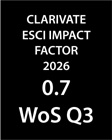
- 2026 Impact Factor (Clarivate): 0.7